Total Pageviews

Tuesday, March 27, 2007

The Crucifixion Expert


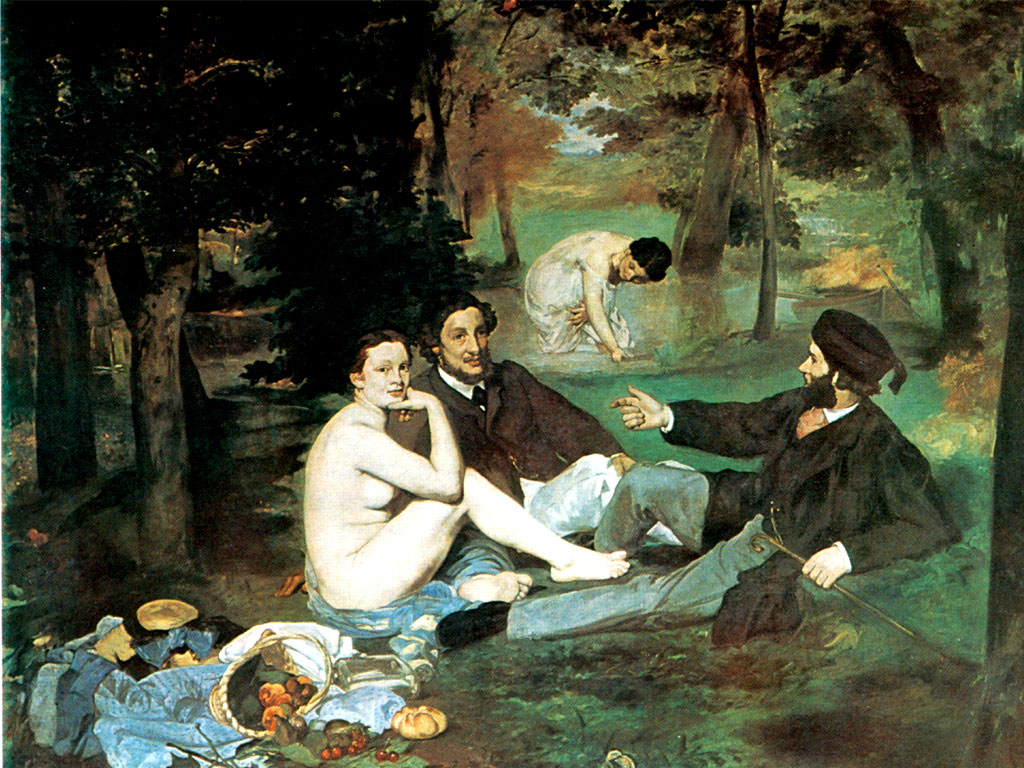
Pieter Paul Rubens drew a crucifixion with special expertise. In the long war between his patrons, the house of Hapsburg in Flanders, and their opponents, the Dutch protestants, there was a crucifixion or a hanging at almost every crossroads in the Netherlands. Thus are memes replicated: the holy symbol becomes reality on the highway.
Here's what one website writes about the war: "(The Duke of ) Alva's errand was to punish those who had been concerned in the disorders at Antwerp and elsewhere. For this purpose he established a Council of Troubles, which was soon called by the people of the Council of Blood. Thousands of men and women, guilty and innocent, were put to death. They were hanged on scaffolds, on trees, at the door-posts of private house. Many of them were poor; but some were the chief citizens and nobles of the country. The whole business of the land was stopped; grass grew in the markets. Every family was in mourning. And against these cruelties the people could do nothing. They had had no experience in war. They were shopkeepers and schoolmasters. The Spanish soldiers had them at their mercy, and they showed no mercy." (The Baldwin Project)
Men crucified everywhere were morbid enough, but Europe had not yet witnessed the first Great Terror, in which the revolutionary government guillotined thousands of French nobles while "les tricoteuses" knitted and gossiped in the front row of the assembled crowds. The British internment and elimination of tens of thousands of the Boer warriors' families in South Africa followed. Turkish genocide of the Armenians came shortly afterwards. The unthinkable slaughter on the battlefields of World War One followed. Then in the 1930s, the Soviets introduced famine as a political weapon, and the knock on the Kulak door in the night. "This is nothing personal, you are being exterminated as a class." Finally, the appalling debauchery of the so-called "final solution", and the complete prostration of Roman Catholicism before the madness of the Bavarian Nazis (Bavaria being Roman Catholic territory). So, you can't help wondering how the Crucifixion of their founding martyr, and its memetic use over the ensuing millennia, helped the Christians develop a fierce sense of compassion for their fellow man. The only Europeans who displayed such feelings were the on-the-ground Communists who actually fought Nazism door-to-door, instead of hiding piously behind their crucifixes.

Sunday, March 25, 2007

Five minutes

Life-drawing jams always include the one-minute impression and the five-minute sketch. I'm trying to improve but I usually spend time on just one part of a nude instead of capturing the essence of the whole in a few broad strokes, as Susan Underwood did here. She also used a big drawing surface and treated it like a memo pad. The result has a zen-like finish.

Wednesday, March 21, 2007

Manography


This picture is by Tara Juneau, who drew it before my eyes at Xchanges a few days ago. Tara says: "I am mostly self taught and have always been passionate about drawing. About two years ago I became very inspired by realist Tony Ryder after reading his book 'The Artists Complete Guide to Figure Drawing' , and have just recently taken a figure drawing workshop with him in Seattle."
Mostly self-taught: that just shows what passion can teach. Tara is working adjacent to the New Realism school and IMO would enjoy hugely a spell with Daniel Greaves at the atmospheric Florence Academy of Art.
She employed an unusual drawing method for the picture above which she explains as follows: "
I used masonite prepared with tinted gesso. I like the surface that the gesso gives, it has a little bit of tooth. It was drawn in 4h and hb graphite (pencil), heightened with white charcoal. I used the harder pencils because they have a higher clay content and give a softer, lighter tone than say a 4 or 6b."
In pondering this realistic mode of drawing, I had several thoughts:
  1. Realism, while ostensibly reducing stylisation to a minimum, is actually a strong stylisation of its own; and
  2. Hockney's book The Secret Knowledge is proved false by the knowledge of these artists, which is no secret; after all, I saw Tara draw the above picture, using no machinery at all and barely the use of a pencil-tip to take the odd bearing; and
  3. Monochrome photography is being beaten at its own game.
In the shower, I decided that a new coinage is required: Manography, derived from Latin manus for hand, and Greek graphos for design. Welcome to the world of manography and Tara Juneau.


Wednesday, March 14, 2007

Signature Portrait

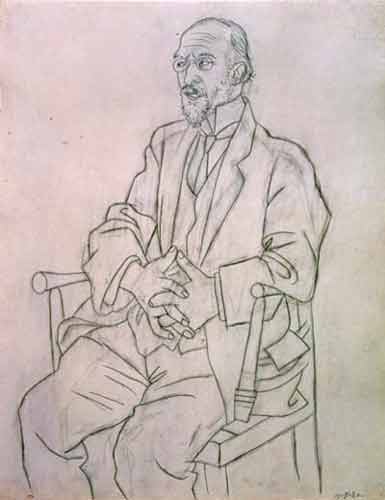
Is this a portrait? A cartoon? Or a signature? Answer: it's a bit of all three: a signaitoon. The wonderfully precocious Jean Cocteau drew this when he was just 21 years old for his older pal Eric Satie. Imagine having the chutzpah to hand someone this idiosyncratic sketch, confident that it would one day be worth big money! Perhaps it's surprising to think that the composer of those delicate Gymnopedies for piano was a Sigmund Freud look-alike. But he had looked somewhat wilder 10 years earlier, in 1900. Cocteau captured him making what was evidently a characteristic gesture, pinching his pince-nez, or spectacles, on to the bridge of his nose. It would have been instantly recognisable to friends of Satie. Picasso met Cocteau and his circle in 1917 and worked with them and Diaghilev on the ballet Parade, to Satie's music. Picasso duly did his own portrait of him in 1920. It's interesting to compare the two, because Picasso much later did signaitoons himself. But his came decades after Cocteau's. Everything Cocteau did had his imprint all over it, and he didn't change styles every few years, the way Picasso did. Cocteau's last hot love affair was with Jean Marais, and get him. His confidence over the Satie sketch was warranted, because Cocteau ended his days, not dying in the gutter like Modigliani, but wearing smart suits in a nice comfy chateau in the country.

Saturday, March 10, 2007

Image manipulation


These two nudes found their way on to one sheet of paper, showing how artists manipulated images millennia before computer whizzes resized, altered and pasted them on screens. In both images on the page, I portray the same model, and so the impossible is laid out before our eyes. It has been shown that Degas used the same method to place dancers originally drawn individually in his studio into groups. In fact, just about all groupings in historic art were produced in the same way. An individual (human, animal) was drawn in the studio, either directly into the group-work, or resized and added to it. You can be sure that Rubens did not gather the family of Jan Breughel the Elder into his studio to paint them all at once. Nor did Botticelli happen upon beautiful, blonde, identical quintuplets in the streets of Florence and invite them to pose for La Primavera. In this way, historic art was closer to drama or masque or tableau than to photography. The artist, in turn, was closer to a magician or conjuror, as he not only created images, but manipulated them. In the virtual worlds conjured digitally today such manipulation is anonymous and routine. In the case of my drawing, it was originally a way to save paper before I noticed its aesthetic appeal. Shame about the missing left hand.

Simulacra


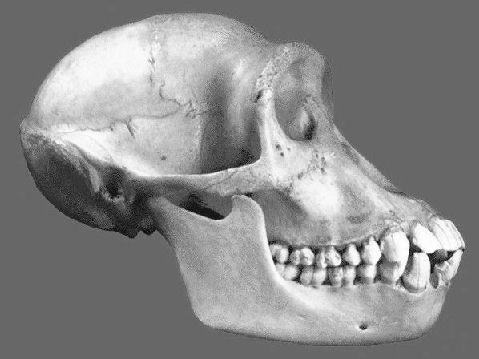
Simulacra are vague likenesses, and they starred in Jean Baudrillard's 1981 book, Simulacra and Simulations. Baudrillard loved juicy disinformation, and illustrators are past masters of it. Nothing can distort and misinform quite so well as a thoroughly misleading drawing. Here's an example: on the right are shown three different skulls in profile, Caucasian, African and Chimpanzee. The African profile is faked to look like a chimpanzee's. On the left are the three supposedly corresponding faces, sharply emphasizing the vast chasm that separates in appearance the god Apollo, a so-called "Creole Negro", and a particularly poorly-drawn chimpanzee. The purpose of these images is to reinforce white racism and Imperialist overlordship. The victim here is the African: such simulacra were deployed by the Nazis to degrade Jews.
The chimpanzee skull is accurate enough, as is the human one. However, the simulacra do not include the skull of the baby chimp, which is far flatter than the adult's, reflecting the Darwinian observation that human adults have an infantilised face.
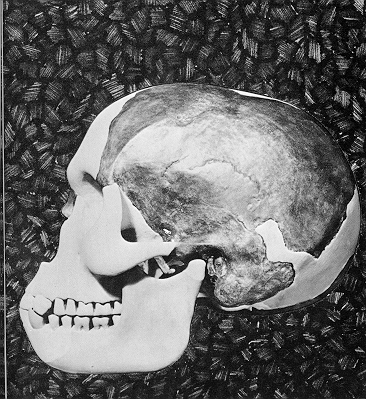
Meanwhile, the "Creole Negro" skull is a grotesque forgery, as demonstrated by this African skull found in a slave cemetary in the USA. Such racist forgeries were common at the time, and even corrupted the world of science in the notorious case of the Piltdown non-man. Note the latitude for forgery in drawing, as opposed to photography.

Friday, March 9, 2007

Sketch portrait


Don Bachardy is a master of the sketch portrait. This one of my hero, Aldous Huxley, probably took him no more than twenty minutes. It's hard to persuade a subject to stay still for much longer than that. It's always been a fantasy of mine to wear a bottle-green corduroy suit, carry a clipboard and pad, and do sketch portraits for money in Montmartre. Bachardy did the same, except around the salons of Los Angeles. (His book of portraits was called Stars In My Eyes.) Last year, it was reported he was still doing it, drawing movie-diva Angelina Jolie in Paris, the pictures to go into the Jolie collection at her hide-out in Namibia.
The sketch of Huxley was done in August, 1962, just fifteen months before his death, which occurred an hour or two after the assassination of JFK on November 22, 1963. To me, there's something wrong with Huxley's hand in the picture, and I don't mean just that it is pointing towards the tongue in which Huxley had suffered fatal cancer since 1960. Either his palm folded in a most unusual way, or Bachardy simply fudged a finger that went wrong. That, or he relocated the edge of the hand. That aside, Bachardy makes Huxley into little more than one line, from above the elbow through the narrow face to the carrot-top hair, which Huxley kept just a little long in the Oxbridge intellectual style. Huxley was very tall, and that's reflected here in the length of the wrist, which looks vulnerable. The eyes are a bit soppily done, glamourised even, considering that Huxley was nearly blind (originally from a nasty disease caught from horrid surroundings at exclusive and expensive Eton College) and normally wore spectacles with thick lenses.
Bachardy's entree into L.A. celebrity circles began when as a young man he moved in with Christopher Isherwood, another Cambridge U emigrant (like myself, although I got my Honours degree, he didn't). They were together for decades, and Bachardy has done numerous nudes of young men. His spare drawing style became his trade-mark, with shadow and line given equal emphasis. However, this sketch of Huxley is a bit of a "sell". I'm not sure Huxley would have approved, assuming he ever saw it properly.